01
The groove or dark circle remains
Possible cause: the tear-trough ligament was not fully released, or fat movement and fixation did not cross the groove.

Under-eye fat repositioning, ultimately where structure is understood.
After under-eye fat repositioning, some patients are left with a persistent groove, hollowing, uneven surface, or recurrent eye bags. Over-removal of fat, an unreleased tear-trough ligament, misplaced filler or fat grafting, and returning bulges all require a cause-based revision plan. ST Plastic Surgery does not just look at the result — we read why it failed. If under-eye fat repositioning is needed again, it should start where the structure is understood.
The key to under-eye fat repositioning is not how much fat is removed, but why the groove is there. ST designs the tear-trough release, fat movement, and fixation point together so the bulge and groove are addressed as one structure.
Dr. Kim personally reviews the under-eye condition and prior procedure history, with multilingual consultation support available for international patients.
Groove, hollowing, recurrent fat, filler, and fat-graft traces are separated first before deciding whether removal, repositioning, or correction is needed.
Under-eye surgery depends not only on the operation but also on recovery. Swelling, asymmetry, and surface changes are followed with care.
Before visiting Seoul, patients can send photos and prior procedure history so ST can guide whether fat repositioning or revision review may be appropriate.

“Under-eye correction begins by identifying the cause: fat, groove, support, pigmentation, prior procedure change, or a mixed pattern.”
Medical references repeatedly discuss remaining grooves, hollowing, surface unevenness, eyelid shape change, and asymmetry after lower-eyelid surgery. ST starts by separating the structural cause beneath what the patient can see.
Possible cause: the tear-trough ligament was not fully released, or fat movement and fixation did not cross the groove.
Possible cause: too much fat was removed, or useful orbital fat was not preserved for the lid-cheek transition.
Possible cause: filler or fat grafting remains unevenly in a thin under-eye plane, or fat placement affects the surface.
Possible cause: lower-lid support, skin shortage, scar tethering, or eyelid position change may be involved.
Possible cause: fat volume, groove depth, skin tone, and prior treatment traces may remain different on each side.

Before operating again, we read the cause again.
A remaining groove, deeper hollowing, or uneven surface after under-eye fat repositioning is not always about how much fat is left. The tear-trough ligament, the movement and fixation of orbital fat, and traces of previous filler or fat grafting must be reviewed together. Before removing or adding more, ST separates the cause of failure first.
The point is not to repeat the same surgery. ST separates the cause, releases the groove, repositions and fixes useful fat, and adds fine support only when the anatomy requires it.
ST separates protruding orbital fat, a tethered tear trough, volume loss, filler or collagen residue, skin laxity, and mixed cases before choosing the method.
The treatment matches the cause instead of chasing the symptom.
The ligament creating the groove is released first so repositioned orbital fat can cross the rim and fill the shadowed transition.
The groove is addressed structurally, not covered temporarily.
Useful orbital fat is preserved, moved over the orbital rim, and fixed so the corrected contour is less likely to fall back into the same bulge-and-groove pattern.
A smoother lid-cheek line without unnecessary fat loss.
When a real hollow remains, ST uses finely prepared fat in the correct plane rather than simply adding bulk under thin skin.
Volume correction supports the repositioning instead of creating a new problem.
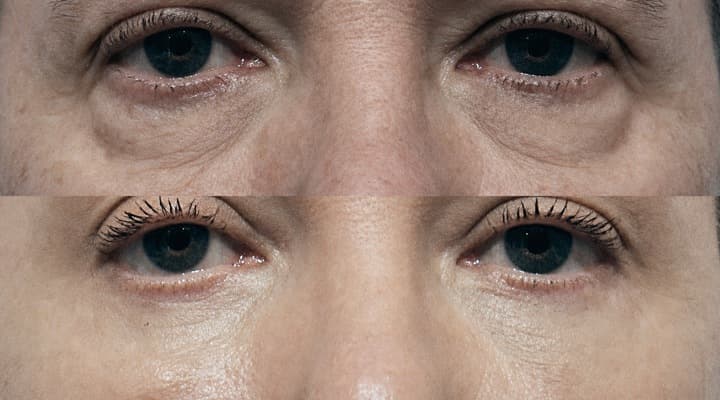 BeforeAfter · 12wInternational 12
Under-eye bags and a tired lower-lid contour are softened by repositioning the fat and smoothing the lid-cheek transition.
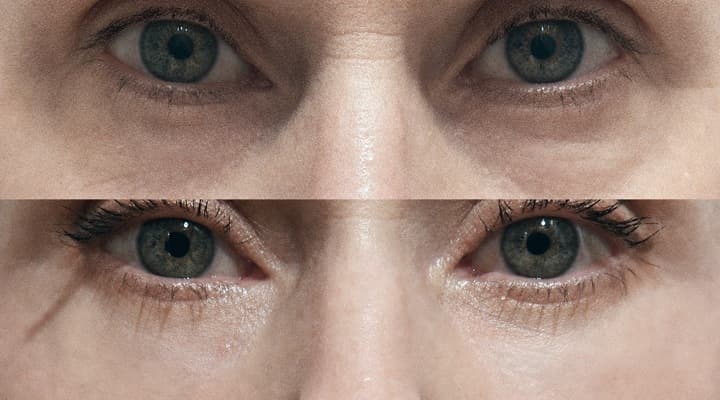 BeforeAfter · 12wInternational 13
Under-eye shadow and a hollow tear-trough are improved by moving fat over the rim, easing the transition into the cheek.
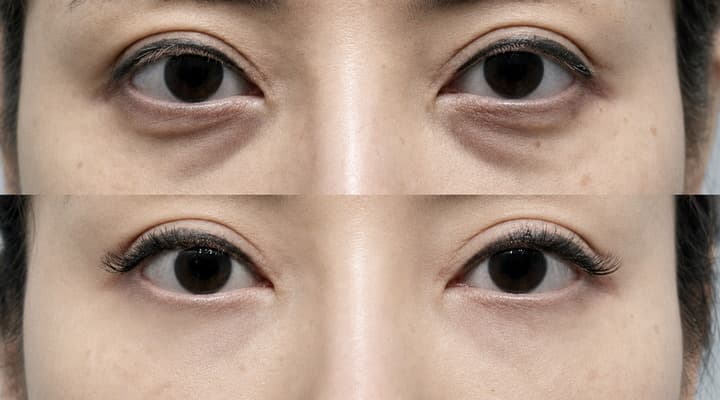 BeforeAfter · 12wInternational 02
Lower-eyelid puffiness and tear-trough hollowing are balanced to create a calmer under-eye line without changing the eye shape.
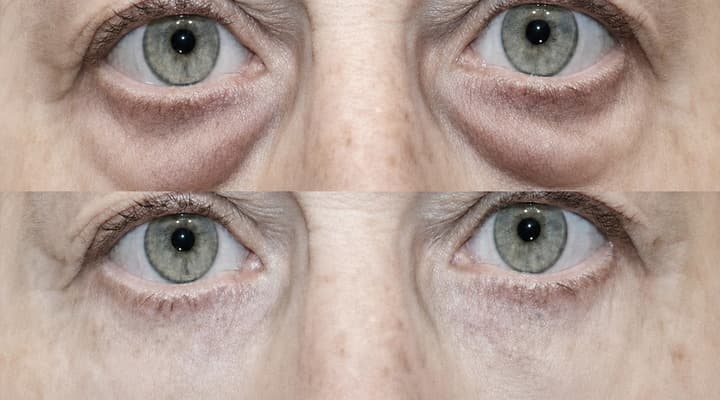 BeforeAfter · 12wInternational 04
A lower-eyelid case with visible bags, hollowing, and skin laxity; the correction focuses on fat position and lid support together.
Sunken eyes, lost aegyo-sal, a changed eye shape, permanent sutures, "you only get one chance" — the claims that circulate in forums and comment sections, checked one by one against what the surgery actually does and why.
Biostimulator injections are marketed as the safe non-surgical option, but the under-eye is the one area where the collagen they provoke turns into fibrosis that outlasts the product. What ST sees in patients who had them first, what to use instead, and what to tell your surgeon if you already did.
The terms surgeons use, in plain language; how to read a credentials block so the lines that matter stand out; and the seven questions that separate surgeries which look identical online — including the one that exposes septal tightening sold as repositioning.
After twenty years of performing the operation, ST's surgeon had it himself. The swelling, the numbness, the one-month asymmetry that made even him doubt, and how it looked at a year — recorded as it happened, and what it changed in how ST counsels patients.
Many patients arrive convinced that repositioned fat always returns — usually after a surgery that never actually repositioned it. What holds the fat in place, what loose skin has to do with it, and how to tell true recurrence from normal healing.
It is not an anti-aging surgery reserved for middle age: bulging fat and dark circles can be congenital, and many conjunctival cases are in their twenties. Why young and older under-eyes bulge for different reasons — and what actually changes with age is the scope of surgery, not the eligibility.
The name on the consent form can describe very different operations — some tighten the membrane around the fat, some quietly remove fat, and some actually move it. Why the simplified versions tend to recur, what the traditional method does differently, and the questions that reveal which one you are being offered.
Patients research methods and side effects, but the detail that decides whether the result lasts is how the repositioned fat is held in place. What external threads through the skin can and cannot hold, why fixing fat to the bone membrane is harder — and why ST chooses internal fixation.
Both operate on the lower eyelid, but one removes fat and tightens skin while the other preserves fat and releases the groove. What each can and cannot fix — and why ST performs incisional fat repositioning instead of conventional lower blepharoplasty.
Watering eyes, blurry vision, tightness, uneven swelling — most symptoms after fat repositioning are the healing process, not complications. A surgeon explains which changes are normal, and the two signs that need a phone call right away.
The diagonal indentation running from the tear trough onto the cheek is held down by a ligament anchored to bone. Why stacking filler on top often makes it lumpier, and what realistically softens the line — without promising to erase it.
A hollow under-eye looks like a simple volume problem, but grafting over an unreleased tear trough can make the valley look deeper. The three hollowing patterns, where filler and fat each fit, and the order that actually corrects the cause.
Recovery differs by method — repositioning alone, added fine grafting, or a skin-incision case. A realistic day-by-day timeline, and when international patients can safely fly home.
An incision inside the lower lid leaves no external scar and can still fully reposition fat. What transconjunctival access does well — and when a skin incision is unavoidable.
Removing fat can flatten a bag but deepen the hollow in the wrong patient, and fat does not grow back. Why repositioning preserves and relocates — stated honestly, not as a universal winner.
Scleral show, a pulled-down lid, or ectropion after surgery is not fixed by re-cutting tissue. Why the support structure itself must be rebuilt, and what a conservative revision can realistically restore.
How the remote photo consultation, the in-person diagnosis, surgery day, and the recovery timeline fit together when you are travelling to Seoul — and what to settle before booking flights.
Filler softens a shadow; repositioning corrects the structure that casts it. An honest comparison of what each can and cannot do, who suits which, and why filler-first is not always the gentler path.
A 10-second mirror test separates the youthful "love band" from the tired eye bag. What each one is, why they are treated differently, and what under-eye surgery should never touch.
Structural shadow, see-through skin, pigmentation, and vascular color are different problems that need different treatment. How to recognise which type you have, and why the order of treatment matters.
A shallow layer of finely processed fat can mask a dark circle that shows through thin skin after the bulge and groove are corrected — it is not a filler for hollows or a fix for an untreated eye bag.
Thin under-eye tissue is unforgiving. Learn why filler, collagen injection, and poorly placed fat can create lumpiness or make revision more complex.
Why some patients still see a groove, recurrent bulge, darker shadow, or hollow after surgery — and how revision is planned around the missed cause.
A practical guide to the core steps: diagnosis, tear-trough ligament release, orbital fat repositioning, fixation, and when fine grafting is added.
You do not need to decide on surgery first. Send photos and prior procedure history, and ST will help you begin comfortably.